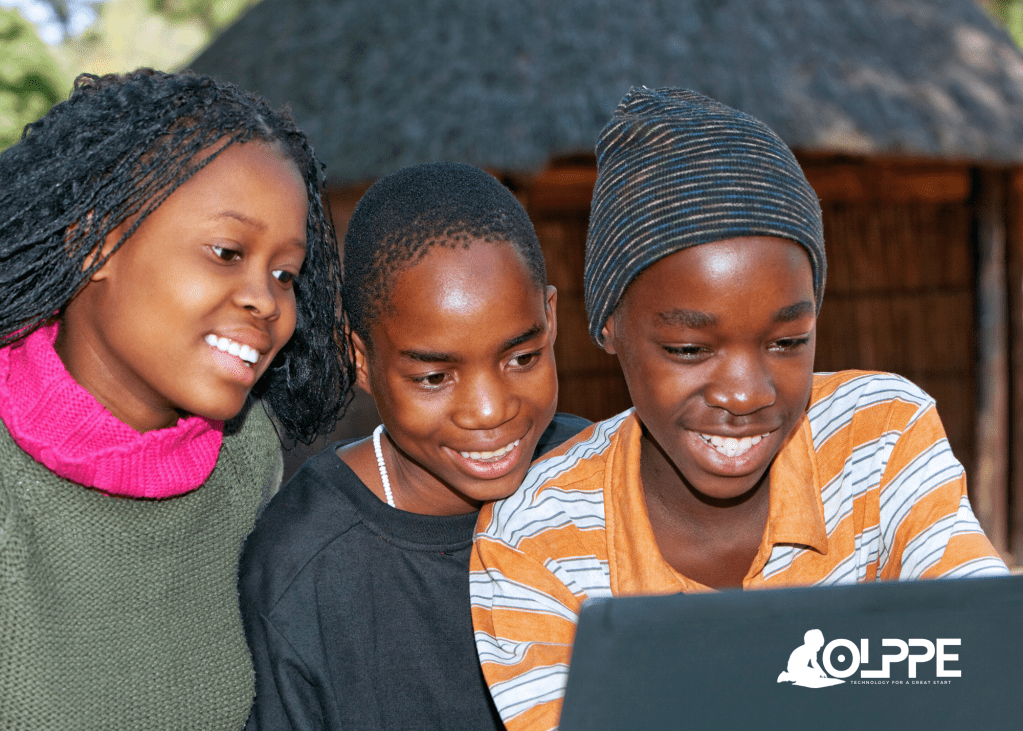
Teacher Insights and the Road to Enhanced Learning
Leading institutions from Ghana, including the University of Ghana, Kwame Nkrumah University of Science and Technology, and the Ghana Institute of Management and Public Administration, have joined forces. Their goal? To enhance the role and impact of technology within primary education.
Introducing the Open Learning Platform for Primary Education (OLPPE): a project dedicated to creating and implementing open e-content, while also establishing methods for seamless curriculum integration. This is all in the aim to elevate learning experiences for primary school students. For the pilot phase, the focus is on one of the cornerstone subjects of education – mathematics, specifically within lower primary education in Ghana.
We’re proud to be backed by CERES and the Jacobs Foundation. Steering this initiative is a team comprising four senior researchers – Prof. Richard Boateng, Dr Sheena Lovia Boateng, Dr Joseph Budu and Dr John Serbe-Marfo – and two distinguished CERES scholars – Obed Kwame Adzaku Penu and Pasty Asamoah.
In a recent development, on 13 September 2023, we conducted our inaugural stakeholder workshop. This gathering of lower primary school mathematics teachers aimed to delve deep into the teaching methodologies of the mathematics curriculum at Ghana’s lower elementary level. The session saw the participation of 19 dedicated educators from both public and private sectors, all with firsthand experience in teaching mathematics to lower primary students.
Highlights from the Workshop
Delving into Ghana’s Primary Mathematics Curriculum
In Ghana’s primary schools, specifically for Basic 1 through 3, the mathematics curriculum is structured around four main strands. Each of these strands, serving as broad areas of study, is further broken down into more detailed topics known as sub-strands. This detailed organization is consistent across both public and private primary institutions in the country, ensuring that all students receive a consistent and comprehensive mathematical education.
Here’s a breakdown of the strands and their respective sub-strands:
- Numbers:
- Counting: A foundational skill, where students learn the basics of numbers and their sequence.
- Representation and Cardinality: Delving into the ways numbers can be represented and understanding the size of a number set.
- Number Operations: Exploring the basic arithmetic operations like addition, subtraction, multiplication, and division.
- Fractions Representation and Relationship: Introducing students to the concept of fractions and their relation to whole numbers.
- Algebra:
- Patterns and Relationships: Cultivating an understanding of mathematical patterns and the relationships between numbers.
- Geometry:
- Lines and Shapes: Introducing students to the fundamental shapes and the lines that form them.
- Position and Transformation: Understanding the positioning of shapes and how they can be transformed through various operations.
- Measurements: Exploring the different ways to measure shapes and spaces.
- Data:
- Data Collection: Equipping students with the skills to gather information effectively.
- Presentation: Teaching methods to present data in understandable formats like charts and graphs.
- Analysis and Interpretation: Training students to draw insights and understand the significance of the data they’ve collected.
This curriculum is meticulously designed to give students a robust foundation, ensuring they are equipped with the mathematical skills necessary for more advanced studies and real-world applications.
How Lower Primary Teachers Gear Up for Class in Ghana
1. Gathering Teaching and Learning Materials (T&Ls):
Both in public and private school settings, the utilization of tangible teaching aids is widespread. Simple, everyday items like oranges, cards, and bottle tops transform into valuable educational tools. Oranges, for instance, are ingeniously used to elucidate the concept of fractions, while bottle tops become counters in number lessons. When planning to use such materials, teachers usually notify their students in advance to bring the required items. Some educators also conduct trial lessons, holding mock classes with children in their local community to gauge the efficacy of their teaching strategies.
2. Lesson Planning:
While embracing modern methodologies, many educators still adhere to traditional preparation methods. They meticulously draft their lesson plans in physical notebooks, revise their content, and assemble their T&Ls, ensuring they are ready to deliver an engaging lesson.
3. Age Consideration in Curriculum Delivery:
Although there’s a typical age bracket for each grade in the lower primary – with 6-year-olds in class 1, 7-year-olds in class 2, and 8-year-olds in class 3 – classroom reality might differ. Teachers often find a range of ages within a single class. Recognizing that comprehension levels correlate with age, they tailor their lessons with the average age of their class in mind. Their primary objective remains consistent: ensuring every child, regardless of age, fully engages with and comprehends the lesson, so no student is left behind.
The Role of Educational Technology in Ghana’s Classrooms
- YouTube as a Teacher’s Resource:
Feedback from the recent stakeholder workshop revealed a fascinating trend: integrating educational technology into class preparation is often a teacher’s personal decision rather than a systemic one. A significant number of teachers turn to YouTube to supplement their understanding of the subjects they’re teaching. This platform provides a wealth of informative videos, which teachers access using their personal devices, such as smartphones or laptops, often on their own dime regarding internet data costs.
- Advanced Tech in the Classroom:
While the use of technology for preparation leans heavily on individual initiative, its in-class application, especially in private schools, is more structured. These privileged students often have access to:
- Tablets: Teachers frequently transfer content, like educational videos, to students’ tablets. This allows students to engage with the material both during class and at home, promoting a blended learning approach.
- Projectors: These devices can transform the classroom into a dynamic learning environment, making it possible to display larger-than-life visuals or videos that can drive home complex concepts.
- ICT Labs: Private school students often have the added advantage of ICT labs. These spaces, equipped with computers and sometimes specialized software, allow for demonstrations that necessitate visual representation. Videos, in particular, are emphasized, as they offer a vivid understanding of certain subjects, enabling students to grasp intricate details of the lessons.
This gradual integration of technology into the learning process not only enriches the educational experience for students but also provides them with a more comprehensive understanding of the subjects at hand.
Incorporating Storytelling into Morning Math Lessons
For public-school teachers in our workshop, the beginning of a math lesson isn’t about jumping straight into numbers or equations. Instead, it’s about weaving a narrative—a technique that not only captures the attention of young minds but also sets the stage for the day’s concept.
Storytelling serves as an innovative way to introduce mathematical concepts, making them more relatable and easier to understand for the students. By drawing from familiar community issues and scenarios, teachers are able to create stories that resonate with the children, placing mathematical ideas within contexts they recognize and can relate to.
Take, for instance, the clever method of using hands to explain mathematical symbols. A teacher might spin a tale of two friends, Right Hand and Left Hand. Right Hand always wants more, while Left Hand is content with less. This narrative then paves the way for introducing the ‘greater than’ and ‘less than’ symbols, using the hands as a mnemonic device.
Such approaches emphasize the creativity of educators, highlighting the art of teaching as much as the science. By grounding abstract mathematical concepts in everyday narratives, teachers ensure that students are not only engaged but also able to see the real-world applications of what they’re learning.
Analyzing the Challenges in Ghana’s Primary Education and Suggested Interventions
Challenges Faced by Students:
- Language Barriers: Not all children are proficient in English or the local languages, which can make comprehension difficult.
- Counting Backwards: Students often struggle to count larger numbers backwards, such as transitioning from hundreds to tens.
- Money Mathematics: The concept of currency, especially with different denominations like cedis and pesewas, can be challenging. Practical problems, like understanding how much more is needed to make a purchase, often trip them up.
- Advanced Arithmetic: Tasks like adding and subtracting two-digit numbers that result in remainders are often challenging.
- Negative Numbers: Grasping the concept of negative numbers and operations involving them, such as placing them on a number line, can be a hurdle.
Challenges Faced by Schools and Teachers:
- Lack of Technological Resources: Many teachers, especially in primary schools, lack technological resources like computer labs, tablets, and consistent internet, leaving them to improvise.
- Security Concerns: Some schools, especially public ones, are vulnerable to theft due to inadequate security measures, discouraging the use of technological tools.
- Electricity Constraints: Many public schools don’t have reliable electricity, further impeding the adoption of electronic or digital technologies.
Suggested Interventions:
- Audio-Visual Content: Given that children respond positively to multimedia, devices equipped with audio-visual content should be introduced. This would cater to different learning styles and promote a deeper understanding.
- Digital Storytelling in Math: Incorporating digital stories in teaching mathematics can help simplify complex concepts and make them relatable, especially for younger students.
- Non-digital Interactive Tools: In places where digital solutions might not be feasible, non-digital interactive tools should be introduced. These would replace the current makeshift tools like fruits and cardboards, offering a more lasting and effective teaching aid.
In summary, while Ghana’s primary education system faces several challenges, both in pedagogy and infrastructure, strategic interventions can significantly enhance the teaching and learning experience for both educators and students.
About the Project:
The Open Learning Platform for Primary Education is funded by CERES and the Jacobs Foundation. The research team, led by Prof. Richard Boateng, can be reached by richboateng[@]ug.edu.gh
Cite as:
Boateng, R., Boateng, S. L., Marfo, J. S., Budu, J., Penu, O. K. A. & Asamoah, P. (2023 September 15). Mathematics in Ghana’s Lower Primary Education: Teacher Insights and the Road to Enhanced Learning. Medium. https://medium.com/@richard.boateng/mathematics-in-ghanas-lower-primary-education-teacher-insights-and-the-road-to-enhanced-learning-9015e830164a
 Open Learning Platform for Primary Education